Month: August 2011

  • Improving Analysis Skills

    Improving Analysis Skills

    According to Dan Heisman in his great article Bootstrapping Analysis Skills

    The following are what make you a good analyst:

    • Will to analyze the position correctly, move after move.
    • Patience to analyze the position thoroughly (but keep in mind the
      clock – see “g”).
    • Analytical thought process to know what steps to take.
    • Board vision to see what is happening (statically) across the entire
      board quickly and accurately.
    • Tactical pattern recognition – the ability to quickly and accurately
      recognize and assess basic safety issues.
    • Visualization to keep the imagined patterns correctly in the mind’s
      eye when looking ahead.
    • Micro time management determines the length of thinking time to
      take before one settles for a “best so far” move, assuming the
      “best” move is not found by then.
    • Deductive logic to see which moves are candidates, and what is
      forced and what is not.
    • Quiescence recognition to know when to stop analyzing lines and
      evaluate.
    • Awareness of danger/criticality assessment, plus the recognition of
      The Seeds of Tactical Destruction.
  • When Solving for Tactics

    When Solving for Tactics


    1. Look at the whole board.

    2. Look for immediate opponent threats.

    3. Narrate tactical themes (Hanging bishop, skewerable or forkable pieces, etc.).

    4. Look at more than one candidate (when you find a good move look for a better one).

    5. Calculate at least 6 ply (3 moves) deep.

    6. Look for in-between moves.

    7. Examine forcing moves first in the order of checks, captures and threats.

    8. When all seems lost, look for stalemate possibilities.

    9. If you feel you are on the right track, but your are not finding the winning move, then try to reverse the move order.

    10. Blundercheck.


  • Playing Against an Outpost

    Playing Against an Outpost


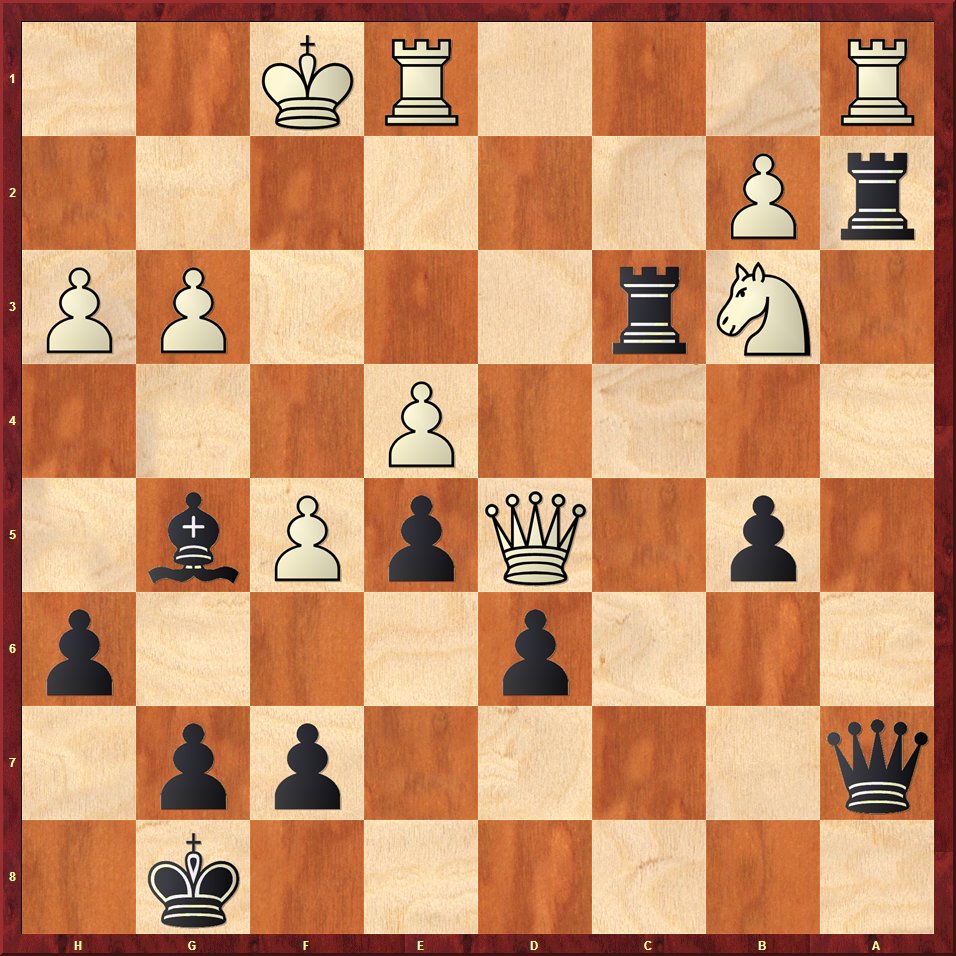
    In the diagram White has an outpost on e5, but Ne5 can always be met by …Nxe5 and after recapturing with the pawn, White’s outpost is gone. White needs to bring another piece to bear on e5, so White to move would play 1.Bg5 and follow it up with Bh4 and Bg3. If on the other hand Black is on the move, he would seek to prevent this with 1…h6, or a more active solution 2…Qe8( so as to meet Bg5 with 2…Qh5! threatening Rxf3) or 1…Qb6. Either move gives Black a fine position.


    If you are unable to cover your opponent’s outpost, then extremely active harassing tactics are needed.


    The diagram is from Unzicker – Fischer, Varna 1962.  If you are unable to cover your opponent’s outpost, then extremely active harassing tactics are needed. In this position the White knight is at least four moves away from reaching d5, this gives Black some breathing room to prevent it, since after the White knight reaches d5 White is lost.

    1… Ra4 Immobilizing the knight. 2. c3 Qa6 3. h3?  Rc8 4. Rfe1 h6 5. Kh2 Bg5 6. g3 Qa7 7. Kg2 Ra2 8. Kf1 Rxc3! White resigns, as after 9.Rxa2 (9.bxc3 Qf2#) Rf3+ 10.Ke2 Rf2+ 11.Kd1 Qxa2 his position is wrecked.

    The lessons to be learned here is that structure alone is not quite everything. The pieces must be able to coordinate with the pawn structure.

    From Stean’s Simple Chess