
Lessons


29
Aug 10

The Philidor Position

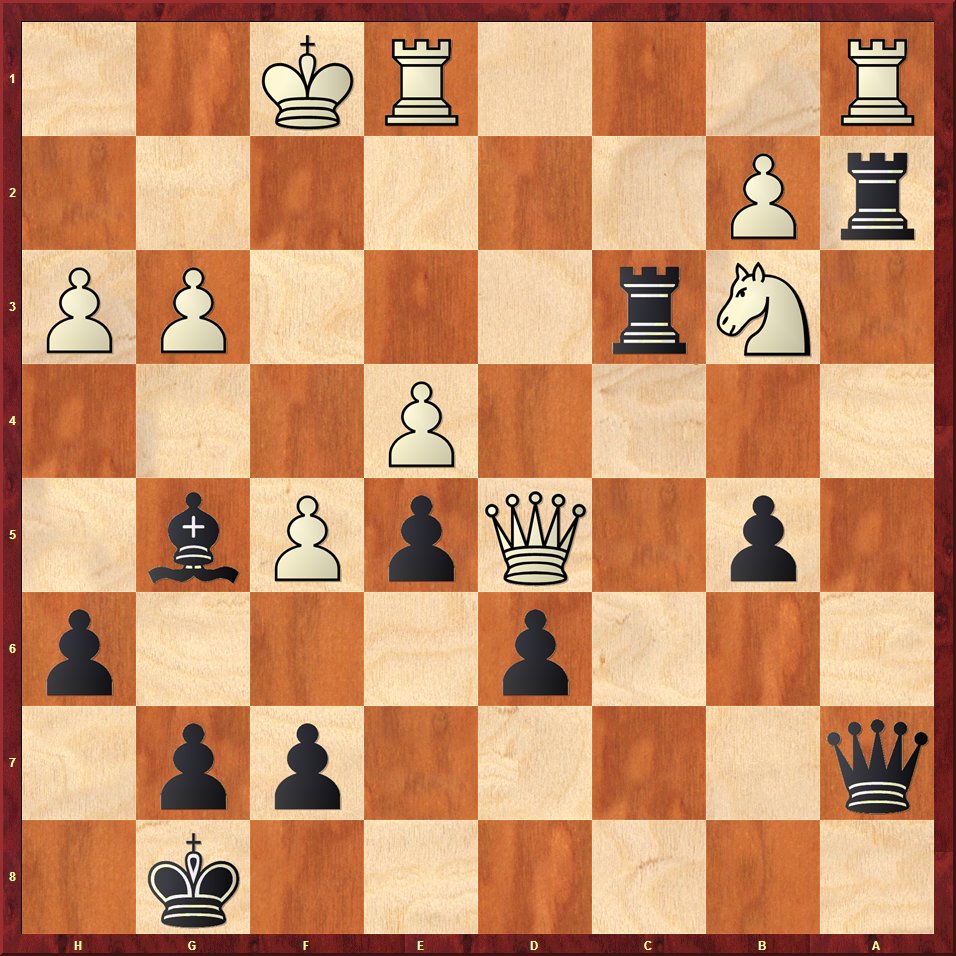
The Lucena and Philidor positions are the most important positions to know when it comes to rook and pawn endings. Here we will be looking at the Philidor position, which allows Black to draw against an opponent that is up a pawn. It’s important to note that the Philidor position only works if the opponent’s pawn has not reached the 6th rank.


Black to move and draw

1…Rb6 This move keeps that White King off the 6th rank. [2.Rg7 Ra6 3.Rg6 Rxg6 Heading into a drawn King and pawn endgame. 4.Kxg6 Ke7 ] The Black rook heads to the first rank, to begin checking the White King. With the White pawn having been pushed, White does not have any cover from the upcoming Black rook checks.

2.e6

2…Rb1

3.Kf6 Rf1+ 4.Ke5 Re1+ 5.Kd6 Rd1+ =


15
Apr 10

Secrets of Zen Chess

Secrets of Zen Chess
During my chess break, I ran into a friend of mine who loves chess and who had been in Japan doing a 4 week Seshin at a Japanese Zen Monestary.I asked him if he had time to practice his chess while at the monestary, and he told me that he had not, but that he had briefly spoken to a monk named Tezin, who also loved chess and was a pretty good player. He told me that Tezin had told him how his chess had improved in the last two years even though he did not practice as much as before he became a monk. Tezin told him that he attributed his chess improvement to what he called the ‘Secrets of Zen Chess’.
I was very interested in hearing these so called secrets of chess improvement, and begged my friend to tell me what Tezin had relayed to him… so here goes:
Less is More
- Less focus on ratings and more focus on enjoyment & playing a beautiful game.
- Less focus on reading books and more focus on practice.
- Less focus on chess and more focus on solving the problems on the board.
Impermanence
- Because the position is always in flux, you need to adapt your plans and be flexible at all times.
- Because of the fluidity of the position, the position needs to be reassessed every few moves.
- Realize that dynamic advantages don’t last forever…take advantage of them while you have them.
Practice
- Practice for the sake of practice.
- Practice for the beauty of the game.
- Practice because you love to practice.
Cause and effect
- Consider the cause and effect of every move.
- Consider how has the position changed after your opponent’s move
- Consider how has the position changed after your move.
- Consider if there are any tactical conditions on the board.
Mindfulness
- Be mindful of the game, you must become one with the board.
- Be mindful of the harmony of your pieces.
- Be mindful of the position, get to the marrow of board.
- Be mindful of threats against you.
- Be mindful of your threats against your opponent.
- Be mindful of checks, captures and threats.
Harmony
- How can I improve the harmony of my pieces?
- How can I disrupt the harmony of my opponent’s pieces?
- How can I improve the weaknesses in my camp?
- How can I create weaknesses in my opponent’s camp?
Mastery lies in a convergence of skills that are already a part of you and not new knowledge derived from books. Mastery lies through practice that will lead you to uncover those things that are already inside you. Mastery lies in being mindful in life and at the board, so that you will know what your opponent’s plan is before your opponent realizes what his plan is. Mastery will be attained once you stop trying to attain mastery.
These are the keys to mastery and these are the secrets of zen chess.

During my most recent chess break, I ran into a friend of mine who loves chess and who had been in Japan doing a 4 week Seshin at a Japanese Zen Monestary.I asked him if he had time to practice his chess while at the monastery, and he told me that he had not, but that he had briefly spoken to a monk named Tezin, who also loved chess and was a pretty good player. He told me that Tezin had told him how his chess had improved in the last two years even though he did not practice as much as before he became a monk. Tezin told him that he attributed his chess improvement to what he called the ‘Secrets of Zen Chess’.

I was very interested in hearing these so called secrets of chess improvement, and begged my friend to tell me what Tezin had relayed to him… so here goes:


Less is More

- Less focus on ratings and more focus on enjoyment & playing a beautiful game.

- Less focus on reading books and more focus on practice.

- Less focus on chess and more focus on solving the problems on the board.


Impermanence

- Because the position is always in flux, you need to adapt your plans and be flexible at all times.

- Because of the fluidity of the position, the position needs to be reassessed every few moves.

- Realize that dynamic advantages don’t last forever…take advantage of them while you have them.


Practice

- Practice for the sake of practice.

- Practice for the beauty of the game.

- Practice because you love to practice.


Cause and effect

- Consider the cause and effect of every move.

- Consider how the position has changed after your opponent’s move

- Consider how the position has changed after your move.

- Consider if there are any tactical conditions on the board.


Mindfulness

- Be mindful of the game, you must become one with the board.

- Be mindful of the harmony of your pieces.

- Be mindful of the position, get to the marrow of the board.

- Be mindful of threats against you.

- Be mindful of your threats against your opponent.

- Be mindful of checks, captures and threats.

Harmony

- How can I improve the harmony of my pieces?

- How can I disrupt the harmony of my opponent’s pieces?

- How can I improve the weaknesses in my camp?

- How can I create weaknesses in my opponent’s camp?

Mastery lies in a convergence of skills that are already a part of you and not new knowledge derived from books. Mastery lies through practice that will lead you to uncover those things that are already inside you. Mastery lies in being mindful in life and at the board, so that you will know what your opponent’s plan is before your opponent realizes what his plan is. Mastery will be attained once you stop trying to attain it.

These are the keys to mastery and these are the secrets of Zen chess.


25
Jul 09

The Outpost

The Outpost

The Outpost


The diagram shows that White has the center and the d-file. In other respects positions are equal. White with the move will attempt operations on the d-file. This presents difficulties since the protected Black pawn at d6 represents a “granite block”. The key move in this position is 1.Nd5 and the knight placed here we call the outpost. By outpost we mean a piece, usually a knight, established on an open file in enemy territory and protected by a pawn. The knight will exercise a disturbing influence due to his radius of attack and will cause the opponent to weaken their position in the d-file, in order to drive him away, by …c6.

  • An advanced outpost forms a base for new attacks
  • An outpost provokes a weakening of the enemy’s position in the file in question.

from My System by Nimzowitch


23
Jul 09

The Step Method in Chess

I stumbled upon a blog post that mentioned the Step Method in Chess, this piqued my interest and I began to research it further. Unfortunately, there is not a lot of information on the Internet, so I have tried to compile as much as I could find about this chess teaching program.

The step-by-step method has been developed by Rob Brunia and Cor van Wijgerden to teach children a Step-by-Step Chess Method to play chess. A large number of schools and chess clubs in the Netherlands and Belgium use this method for their chess lessons. The Step Method is intended to take students from the basics all the way to an approximate ELO rating of 1900 after the student has mastered step 5, and to an approximate rating of 2100 once they master the self-directed 6th step.

This method consists of six steps.

Step 1

Rules of the game and basic skills are covered in step 1.

15 lessons:

1: Board and pieces
2: Moves of the pieces
3: Attacking and capturing
4: The pawn
5: Defending
6: Check and + getting out of check
7: Mate
8: Mate
9: Castling
10: Profitable exchange
11: Twofold attack
12: Draw
13: Mating with the queen
14: Taking ‘en passant’
15: The notation
Continue reading →


6
Jul 09

Chess Training Schedule

Day 1
Study endings (1hr)
Solve tactics (30min)

Day 2
Study strategy (1hr)
Solve endings (30min)

Day 3
Play long game (1hr)
Solve tactics (30min)

Day 4
Solve strategy (1hr)
Solve tactics (30min)

Day 5
Study openings (1hr)
Solve endings (30min)

Day 6
Play long game (1hr)
Solve tactics (30min)

Day 7
Off day


27
Jun 09

Chess Board Visualization Exercises

While many claim that improved board visualization leading to the ability to play blindfold chess is the result of playing chess over a period of time, some people need to work on this ability through a board visualization exercise regimen.

Board visualization training will improve your ability to calculate long variations. Training should take place 3-4 times per week in 5-10 minute sessions.

Board Visualization Exercise #1

Arrange the pieces on a board and look at the normal developing move for all the pieces. The White knights develop to c3 and f3, while the Black knights develop to c6 and f6. The light squared bishop develops to e2,d3,c4,b5, etc. Once you have studied the knights, bishops (regular and fianchetto positions) the castled King and rook and the four central squares (e4,d4,e5,d5) you remove all of the pieces and point and name out loud all of the normal developing squares for the pieces.


26
May 08

Lucena Position

Lucena Position Silman calls the Lucena Position “The Holy Grail of Rook Endings”. In this position Regardless of who’s turn it is to move, White wins.

1.Rf2+ Forcing Black’s King to leave the scene of the battle.

1…Kg7 [1...Kg6 2.Rf4 Kg5 3.Rd4 Kf6 4.Ke8 Re1+ 5.Kf8 Rf1 6.d8Q+ Ke5+ 7.Ke7 ]

2.Rf4 Building a bridge.

2…Kg6 3.Ke7 Only now should White leave the cover of his pawn. Since promotion is threatened Black must go into checking mode.

3…Re1+ 4.Kd6 Rd1+ 5.Ke6 Re1+ 6.Kd5 Rd1+ 7.Rd4 Rxd4+ 8.Kxd4 Kf6 9.d8Q+ 1-0


12
May 08

Virtual Chess Coach Part II : Study Schedule

Study Schedule

Day Topic 1 (30m) Topic 2 (1hr)
Monday Solve Tactics Study Endings
Tuesday Play Annotate game *
Wednesday Solve Endings Study Strategy **
Thursday Solve Tactics Solve Strategy ***
Friday Solve Tactics Study Openings
Saturday Solve Tactics Solve Strategy
Sunday Play Annotate game *

Legend:

* If you run out of time during daily session, you can finish annotating your game during the study openings session

** Study strategy by going over annotated master games

*** Use Stoyko Exercises format


Virtual Chess Coach Pt I


7
May 08

Virtual Chess Coach – Part I

About the Virtual Chess Coach Program

This program is geared for my improvement (a 35 year old 1278 USCF rated player), but I hope that others in a similar situation will be able to derive benefit from it as well.

I will be modeling this program on the teaching’s of Dan Heisman. Dan Heisman is one of the best chess teacher’s in the United States and if you don’t already know this, then run to danheisman.com and check out his Novice Nook articles at Chess Cafe.

Now not all of us can afford a chess coach, so we will be using books and information available on the web (Heisman’s Novice Nook Articles) to create a virtual chess coaching experience. If you can afford a coach, then there is no substitute for the hands on feedback that they can provide but I’m aiming to make this the second best thing.

Things to know before we go on:

  • This program is aimed at the adult beginner / intermediate player (ELO 1200 – 1700)
  • Our chess philosophy will be based around Dan Heisman (with a sprinkle of Purdy and Silman for good measure)

Absolute Beginners

For complete beginner’s to chess Heisman recommends they start with The Complete Idiot’s Guide to Chess and then go to a basic chess tactics book like John Bain’s Chess Tactics for Students. After doing this you should be approximately 1200 ELO and then this guide will be more useful to you.

The Assessment Phase

We need to assess our strengths and weaknesses, yet we are in no position to do so (how can we assess what we do not know / understand). This is one of the weaknesses of not having the feedback mechanism a coach provides. But do not fret, there is a great book that helps you assess your strengths and weaknesses in chess, and that book is Igor Khmelnitsky’s Chess Exam and Training Guide. After going through Igor’s book, you will have an idea of which areas of your chess need to focus your improvement efforts.

Assessing Your Games

Another area where a coach can provide much needed feedback is in going over your games. Because we’ll be going at it on our own the following process is very important in order to get a close benefit to that of having a real coach.

  • Go over all of your losses.
  • Quickly re-play the game again making light annotations
  • Go over the game in detail, and this time make extensive annotations and analysis
  • Go over the game with a chess engine and compare your annotations with those of the engine

Key things to look for when annotating your game

You should jot these down as part of your annotations and include them in your chess notebook

  • See where you could have improved in the opening
  • Look for missed tactical opportunities (both defensive and offensive)
  • Look for missed positional opportunities
  • Look for missed opportunities in the endgame, if necessary refer to Mueller’s Fundamental Chess Endings
  • Look for moves that caused a shift in the game based on the engine’s evaluation. (any move with an evaluation change greater than .35) and find out the root cause behind the evaluation shift, then go back to your annotations and make sure you address this and don’t forget to add this to your chess notebook.

The games you annotate and go over, should be standard time control games if possible. You should make an effort to play at least 1-2 standard games (>= G/30) per week. You can do this by either joining the Team 45 45 league, or playing ICC’s Standard Tourney or even playing at your local chess club. These games will give you more food for thought than quickly played blitz games, but if you do not have at least 1 standard game to go over, then do go over your well played blitz games (which is better than not going over your games at all).

Thought Process Before Lessons

There are certain bad habits that you should eliminate before you consider taking lessons, otherwise you would be throwing your money away. Most of these stem from careless play or hope chess .

  • Do not leave pieces en prise
  • Do not move quickly and without thought
  • Perform a blundercheck before playing your move

Reference

The following books and websites will be used for this program:

Tactics

Back to Basics Tactics

Chess Tactics for Beginners (Convekta)

Endgames

Silman’s Complete Endgame Course

Strategy

The Art of Logical Chess Thinking

Thought Process

Everyone’s 2nd Chess Book

Play


7
Feb 08

De La Maza for the Rest of Us

Tactics Program

This tactics training program should not take more than 30 minutes per session, and it is flexible enough where you can adjust the amount of puzzles and / or the amount of time spent per puzzle as well as the session time so that you can customize it to your needs and study time available.

Week 1

Day 1 = 10 puzzles @ 3 minutes per puzzle
Day 2 = 10 new + 10 from day 1(d1) = 20 puzzles @ 1.5 min / puzzle
Day 3 = 10 new + 10d1 + 10d2 = 30 puzzles @ 1 min / puzzle
Day 4 = 10 new + 10d1 + 10d2 + 10d3 = 40 puzzles @ 45 sec / puzzle
Day 5 = Review previous 40 questions @ 35 sec / puzzle

Week 2

Days 1-4 are the same as week 1
Day 5 Repeat 40 questions from week + include 10 random questions from the previous week for a total of 50 questions @ 35 sec/ question.

Resources

Since we will be using a smaller pool of puzzles, it is very important that the puzzles selected provide the user with the most critical patterns so that you can get the most benefit out of your study time.

While you can use any book or software that contains rich tactical / strategic positions, the following two books contain 900 critical positions that will assist you in getting the most out of your training time: